The peninsula that is unlike anywhere else in Provence
There is a stretch of land on the southern tip of the Var that does not quite behave like the rest of Provence. It sits far enough south that on a clear day the horizon feels genuinely open, the sea pressing in from three sides and the islands of Hyères visible close enough to make you want to take the boat. Between the village at its tip and the mainland to the north lies a landscape that most visitors to France have never seen: a double land bridge enclosing a vast salt marsh, pink flamingos picking their way through shallow water, and vineyards producing AOC Côtes de Provence wine in near-total silence. This is the Presqu'île de Giens, and it is genuinely one of the most unusual places you can spend a few days in the south of France.
Where exactly is Giens, and how does it fit into the wider region?
The Presqu'île de Giens sits at the southern edge of the commune of Hyères, in the Var département of Provence-Alpes-Côte d'Azur. It is not a place you pass through on the way to somewhere else. You come here because you are coming here. In terms of its position within the broader region, Giens is well placed for guests who want both the peace of an out-of-the-way peninsula and easy access to some of the most significant destinations in the Var and the Côte d'Azur. Toulon, the historic naval city and the largest city in the Var, is approximately 30 minutes by car to the west. Saint-Tropez and the wider Gulf of Saint-Tropez are approximately one hour to the east along the coast road. Aix-en-Provence is around 90 minutes to the north-west. Marseille is approximately 90 minutes to the west via the A50 then A57 motorway.
Hyères itself, the nearest town and the administrative centre of the commune, is 15 minutes from the peninsula by car and worth a half-day in its own right. Its medieval old town climbs a hillside above a grid of Belle Époque streets, and it was once one of the most fashionable winter resorts in Europe, visited by Queen Victoria, Robert Louis Stevenson and Leo Tolstoy. The Olbia archaeological site on the edge of the peninsula is the remains of a Greco-Roman settlement and is accessible as part of a guided tour from Hyères.
The Îles d'Or - Porquerolles, Port-Cros and the Île du Levant - are all reachable by ferry from the peninsula. Porquerolles, the largest, departs from La Tour Fondue at the southernmost tip of the eastern tombolo. The crossing takes approximately 20 minutes. Port-Cros, which is a national park and one of the few truly car-free islands in the Mediterranean, is also accessible from nearby Hyères port. For guests staying on or near the peninsula, a day on Porquerolles - with its pine forests, empty beaches and single village - is one of the most straightforward and rewarding excursions in the entire Var.
The geography | why Giens is unlike any other peninsula in France
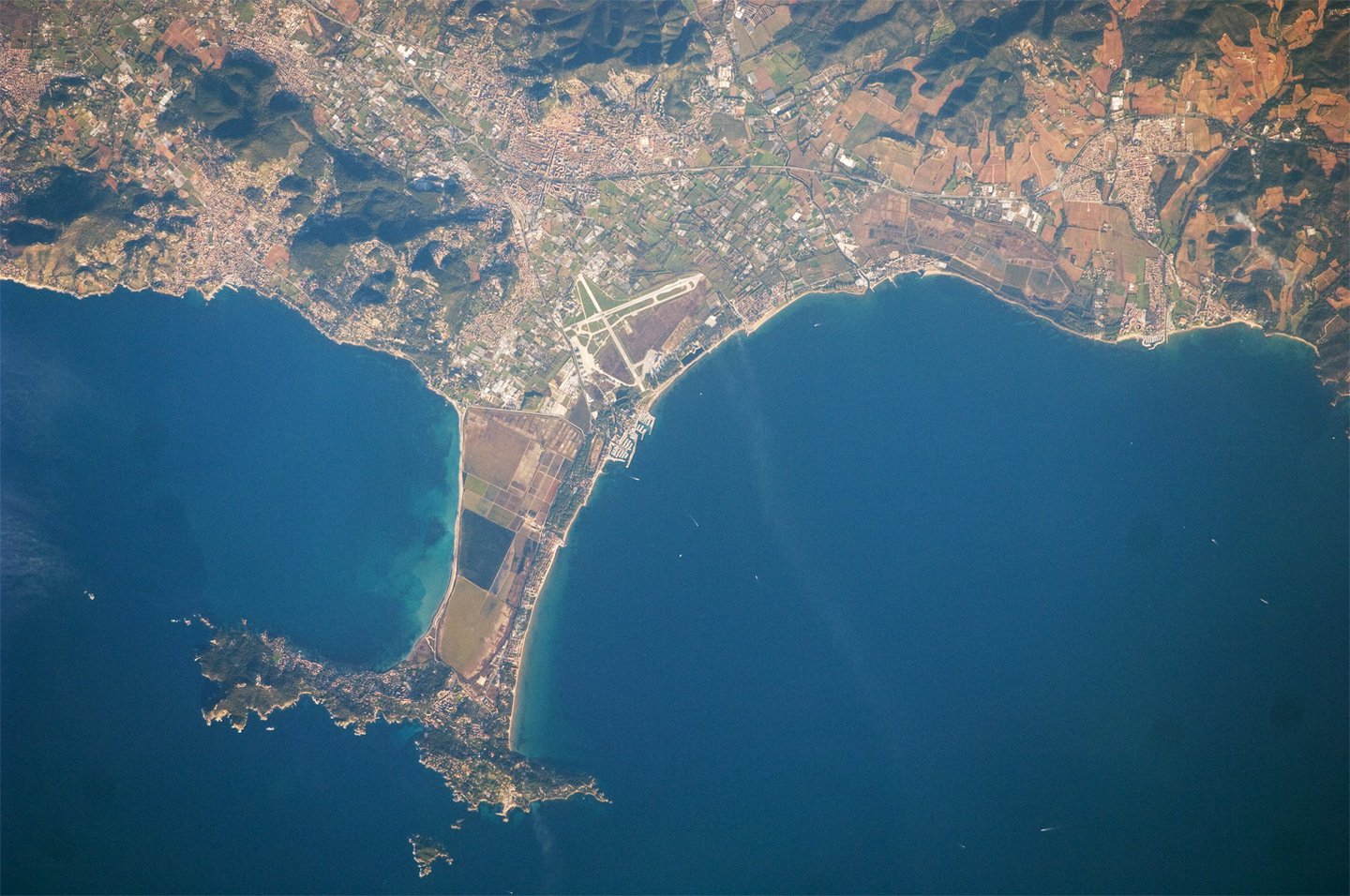
Three thousand years ago, Giens was an island. Like its neighbours Porquerolles, Port-Cros and the Île du Levant, it was part of the archipelago the ancient Greeks called the Stoechades, meaning the aligned ones, a reference to the way the islands sit in a row off the coast. Over the centuries, sediment carried down by the rivers Gapeau and Roubaud gradually built up on either side of the island, and two narrow strips of land slowly extended south from the mainland to connect it. The process took millennia, and it is still, technically, continuing.
The result is a geological formation so rare that it has a specific name: a double tombolo. There are only a handful of double tombolos in the world, and Giens is one of the most accessible and well-preserved. The two land bridges, one to the east and one to the west, run roughly parallel to each other for approximately five kilometres, enclosing between them the Étang des Pesquiers, a 500-hectare lagoon and former salt marsh. From above, the whole structure looks like a lollipop on a double stick.
The Étang des Pesquiers was a working salt marsh from 1848 until 1996, at its peak producing 30,000 tonnes of salt per year. Since production ceased it has been classified as a nature reserve and is now one of the most important bird habitats in the western Mediterranean. Pink flamingos are its most famous residents, but ornithologists come for much more: herons, avocets, peregrine falcons, kestrels, hoopoes and dozens of migratory species pass through or take up residence across the seasons. The salt road, Route du Sel, runs along the eastern tombolo and gives a view across the lagoon that in the right light = late afternoon in autumn, when the flamingos are wading and the sky is turning - is as quietly spectacular as anything in Provence.
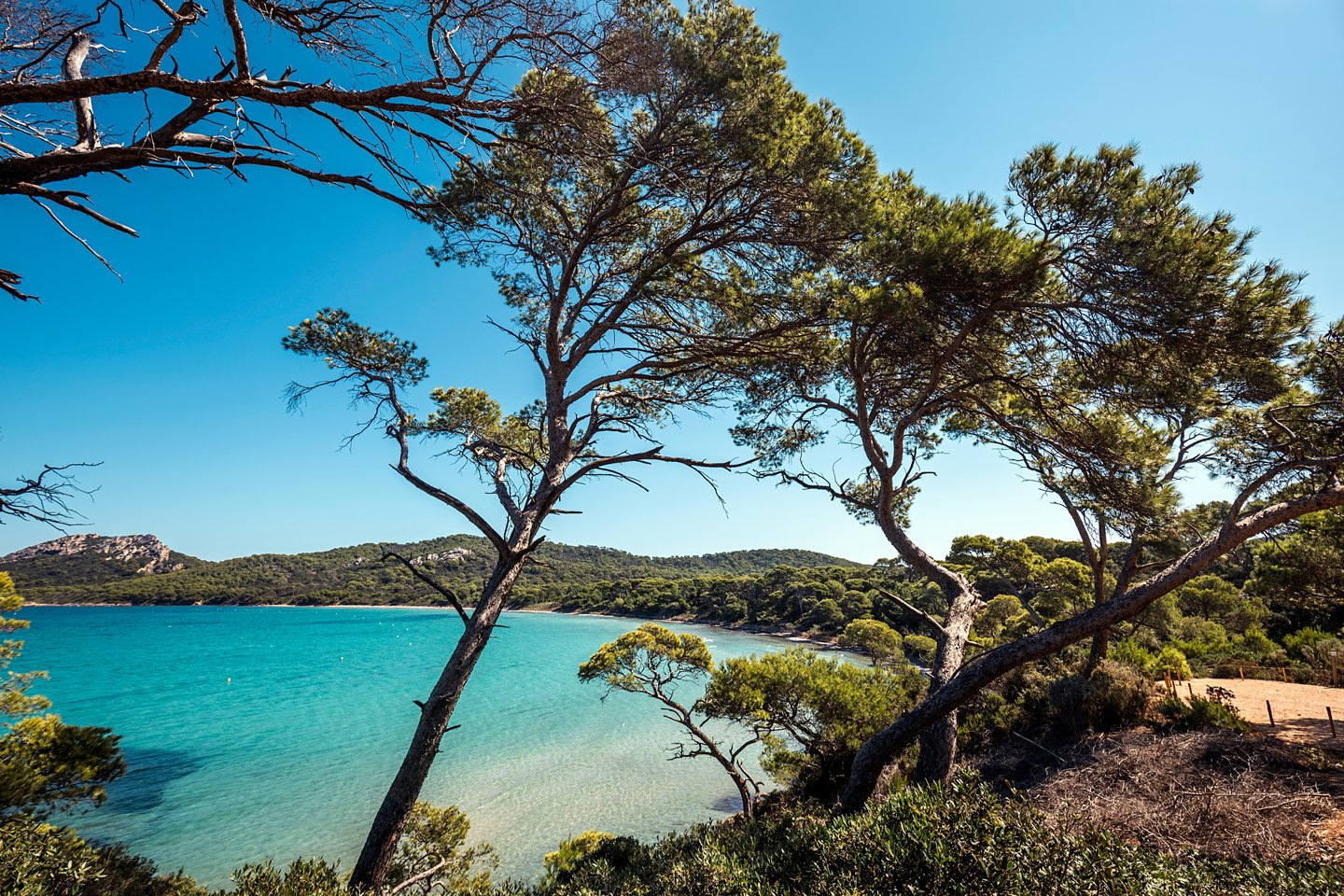
The geography of the peninsula also means that whatever the wind direction, there is always a sheltered beach somewhere. The west tombolo, exposed to the prevailing winds, is the domain of kitesurfers and windsurfers. The east tombolo, sheltered from the Mistral, has calm, shallow water ideal for families. The southern tip has wild coves accessible only on foot. Each coastline feels like a different place.
A history worth knowing
The history of Giens is long enough to take seriously, and specific enough to make a walk through the village feel like it means something. In antiquity the peninsula was part of the Stoechades archipelago and the site of Olbia, a Greek trading colony founded around 330 BC by settlers from Massalia - present-day Marseille. Olbia was a significant Mediterranean port, and its remains, excavated from the late 19th century onwards, include the foundations of houses, thermal baths, sanctuaries and commercial premises. The archaeological site sits at the northern end of the Plage de l'Almanarre on the west tombolo and is accessible via guided tours arranged through the Hyères tourist office.
In the 8th century, Saracen occupation left its mark in the place names. The word Almanarre itself comes from the Arabic Al-Manar, meaning lighthouse or beacon, a reference to the watchtower that stood on the site during the period of Saracen control of the Provençal coastline. This is why the beach is called l'Almanarre, and why the name has been on maps in various forms ever since. In 1220, the Abbey of Saint-Pierre de l'Almanarre was founded on the site of the ancient Greco-Roman settlement, its builders using the stones of the Roman ruins in its construction. The abbey has not survived intact, but the layering of history on that single patch of ground - Greek colony, Roman town, Saracen watchtower, medieval abbey - is the kind of thing that rewards standing still for a moment.
The rocky southern part of the peninsula gradually developed its own settlement over the following centuries, growing around a hilltop watchtower into the village that is today called Giens. In the 17th century, a coastal battery was constructed at the southernmost tip, known as the Tour Fondue, from the Provençal word fondudo meaning crumbling or ruined, which suggests it was already falling apart not long after it was built. The tower still stands at the water's edge next to the ferry port.
On 18 March 1879, the French navy battery-ship Arrogante was driven aground in a storm on the Plage de la Badine on the south-western coast, with the loss of 50 sailors. A local doctor named Léon-Émile Vidal was commended for his treatment of the survivors and is commemorated with a heritage plaque in Hyères. A memorial to the wreck stands in the village cemetery. It is one of those local tragedies that a place absorbs quietly, and the Badine beach carries the name of the ship to this day.
The peninsula was also the final home and resting place of Saint-John Perse, pen name of Alexis Leger, French poet and diplomat, who won the Nobel Prize for Literature in 1960. He died on the peninsula in 1975 and is buried in the village cemetery at Giens. For those who know his work - vast, oceanic poetry that takes the sea and exile as its central subjects - the fact that he chose to spend his last years on this particular peninsula makes perfect sense.


The village of Giens |what to see and what not to miss
The village of Giens sits on the rocky high point at the southern tip of the peninsula, about 40 metres above the sea. It is small, unhurried and genuinely Provençal in character - no beach boutiques, no crowds, no souvenir shops selling lavender sachets. What it does have is a handful of specific things worth seeing and a viewpoint that is one of the best on the entire Var coast.
Square Boualam is the site of the old Château de Giens, of which almost nothing physical remains. The château was demolished long ago and the site is now a small public garden with an artist's studio. It does not sound like much, but the views it offers are exceptional: south across the open Mediterranean towards the Îles d'Or, and north across the bay of Almanarre, the salt marshes, the twin tombolos and the city of Hyères in the middle distance. If you visit Giens for one hour, stand here.
The Église Saint-Pierre was built in 1833 on the site of an earlier chapel and renovated between 1988 and 1997. It is a small church, simply decorated, but worth going inside for the painted seascapes in the side chapels. These depict the bay of Almanarre, the isthmus and the Pointe des Mèdes - an unusual subject for sacred art, and a reminder that this is a fishing community and always has been. Saint Peter is the patron saint of Provençal fishermen, which is why the church is dedicated to him.
Port du Niel is a ten-minute walk downhill from the village and is the most picturesque of the small ports on the peninsula. It holds perhaps a dozen fishing boats, the water is clear enough to see the bottom, and the restaurant Le Poisson Rouge sits on the hillside above it with a terrace looking straight down over the crique. Go in the early morning if you want to see the fishermen, or at sunset if you want to see it at its best.
The coastal path from Port de la Madrague around the south-western tip of the peninsula is the finest walk on the Giens peninsula and one of the better coastal walks in the Var. The path runs approximately seven kilometres along clifftops and through Mediterranean scrubland, with views across to the Îles d'Or, descending occasionally into small sheltered coves. It is not difficult but it is uneven in places. Allow three hours for the full loop. In summer, sections of this path can be closed in the event of high fire risk - check locally before setting out.
The Pradeau fort at the southern tip and the Tour Fondue at the ferry port are both worth a brief stop. The Tour Fondue dates from the 17th century and sits right at the water's edge next to the Porquerolles ferry departure point. The fort at Pradeau contains a small local museum. Neither requires significant time, but both add texture to a day spent exploring the southern end of the peninsula.
The Olbia archaeological site at the northern end of the Almanarre beach is the remains of the Greek and Roman settlement that stood here for several centuries. It is one of the most significant Greco-Roman sites in the Var and is notably under-visited compared to better-known sites elsewhere in Provence. Guided tours are available through the Hyères tourist office and are strongly recommended as the site makes considerably more sense with context.
What to visit nearby |day trips and excursions
The peninsula's position makes it an excellent base for exploring the wider Var without ever needing to travel far.
Porquerolles is the obvious first excursion. The ferry from La Tour Fondue takes 20 minutes and runs regularly from April through October, with reduced services in winter. The island has no cars beyond a few service vehicles, its beaches are among the finest in France, and its single village has enough restaurants and cafés for a full day. Bicycles can be hired from several outlets in the village.
Port-Cros is the second of the Îles d'Or and the most ecologically protected. The entire island and its surrounding waters form a national park. There are no cars, very limited facilities and walking trails through dense Mediterranean forest down to secluded beaches. The snorkelling along the underwater trail at the Calanque de la Palud is exceptional. The ferry departs from Hyères port rather than La Tour Fondue.
Hyères old town is just 15 minutes by car and is worth at least a half-day. The medieval quarter climbs a hillside to the ruined Château d'Hyères, which offers views back over the peninsula and the islands. The Villa Noailles, a remarkable Cubist villa designed in the 1920s for the Vicomte and Vicomtesse de Noailles, is now a museum of design, architecture, fashion and visual arts and is one of the most architecturally significant buildings in Provence. The covered market on the Place Massillon runs every morning and is excellent.
Toulon is 30 minutes to the west and offers a full day's worth of sightseeing: the old port, the naval museum, the market on the Cours Lafayette which runs for over a kilometre, and a hilltop cable car to Mont Faron. It is the kind of city that rewards wandering without a plan.
The Massif des Maures begins almost immediately to the north-east of Hyères and offers a complete change of landscape: dense forest, cork oaks, chestnut trees and the perched villages of Collobrières, Bormes-les-Mimosas and La Garde-Freinet. From Giens the massif is less than 30 minutes by car and the contrast with the coastal landscape could not be more complete.
Market days on the Giens peninsula
Markets on and around the Presqu'île de Giens are well spread across the week, which means that wherever you are based, there is usually one within easy reach on any given day.
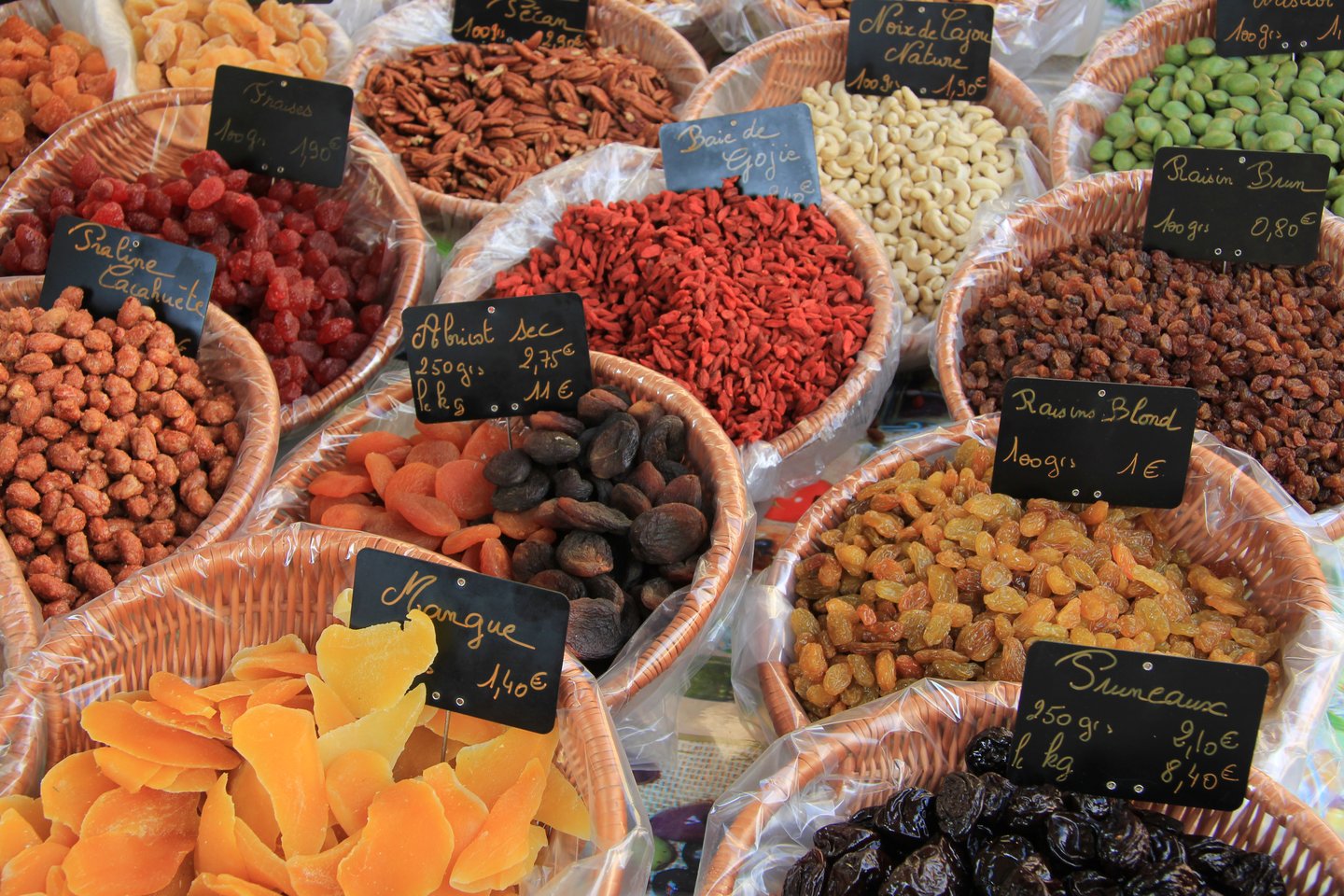
Tuesday morning: The Provençal market in the village of Giens. This is the main weekly market on the peninsula and the one most worth planning around. Olives, tapenade, anchovies, local cheese, seasonal fruit and vegetables, honey and, when the fishing has been good, fresh fish from the ports of Niel and La Madrague directly. The fishermen of Port du Niel work from traditional pointus and sell sea bream, sea bass and red mullet when the catch is in.
Friday morning: Marché de la Capte, in the small community on the east tombolo.
Sunday morning: Market at the Port d'Hyères, running from Easter to the end of September. Larger and more varied than the village market, with a broader selection of producers.
Saturday morning: Farmers market in Hyères, 15 minutes by car from the peninsula. The best option for serious Provençal produce shopping.
**The annual village festival Giens 1900 takes place every year on the Whit weekend (Pentecôte) and recreates the atmosphere of the peninsula at the turn of the 20th century. It's the kind of local event that goes largely unreported outside the Var but is exactly the sort of thing that makes a holiday feel like it has reached somewhere real.
When to visit
May and June are the best months for most visitors. The weather is warm, the sea is coming up to swimming temperature, the peninsula is quiet by high-season standards and the light is exceptional in the evenings. The Étang des Pesquiers is at its most active with migratory birds in spring.
September is the other outstanding month. The summer crowds have thinned, the sea is at its warmest, the days are still long and the AOC Côtes de Provence vineyards on the peninsula are moving into harvest season.
July and August are beautiful but busy. The tombolos in particular can be crowded, parking is difficult and the southern coastal paths are occasionally closed due to fire risk. Come early in the morning or late in the afternoon for the beaches.
October through April is genuinely good for walking, cycling and birdwatching. The peninsula empties considerably and the landscape takes on a different character. Some restaurants and facilities close in winter, and the Route du Sel is closed from roughly November through March.
A Provence Holidays villa in the Var puts you within easy reach of the peninsula and everything around it. Whether you are planning a day on Porquerolles, a morning at the Tuesday market in Giens village, or an evening at one of the port restaurants, the peninsula rewards the kind of unhurried exploration that a private villa makes possible. Browse our villas in in the South of France and speak to our concierge team about building an itinerary around the Presqu'île de Giens.
À bientôt