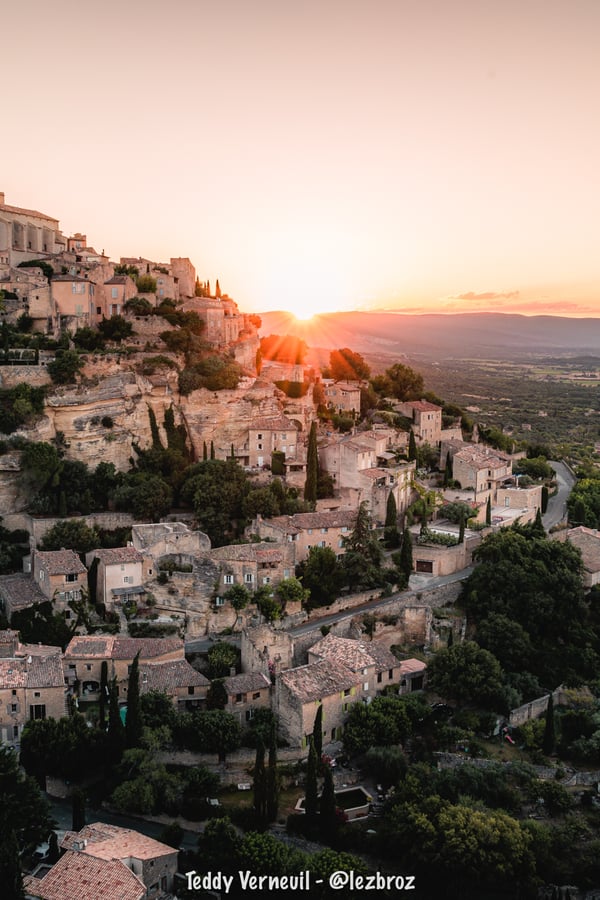
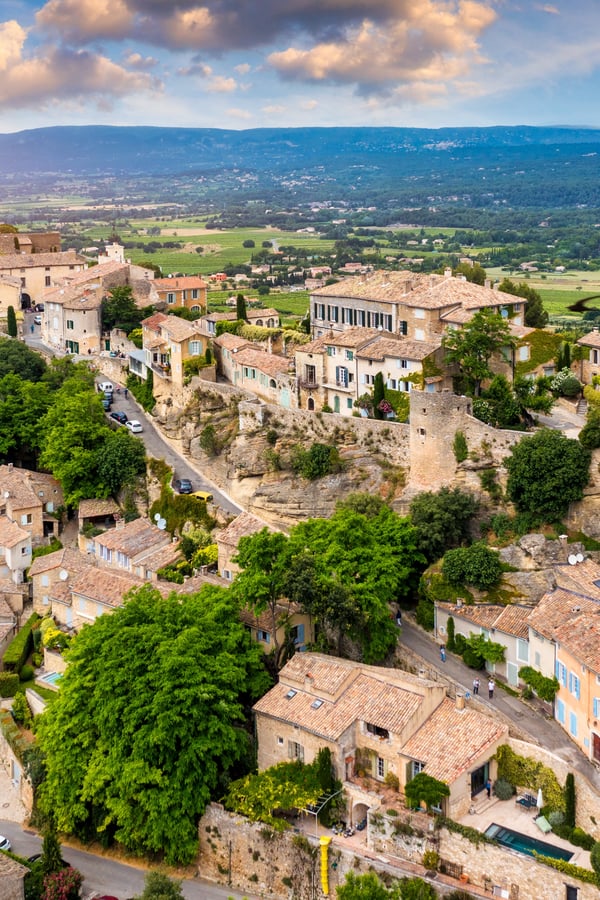
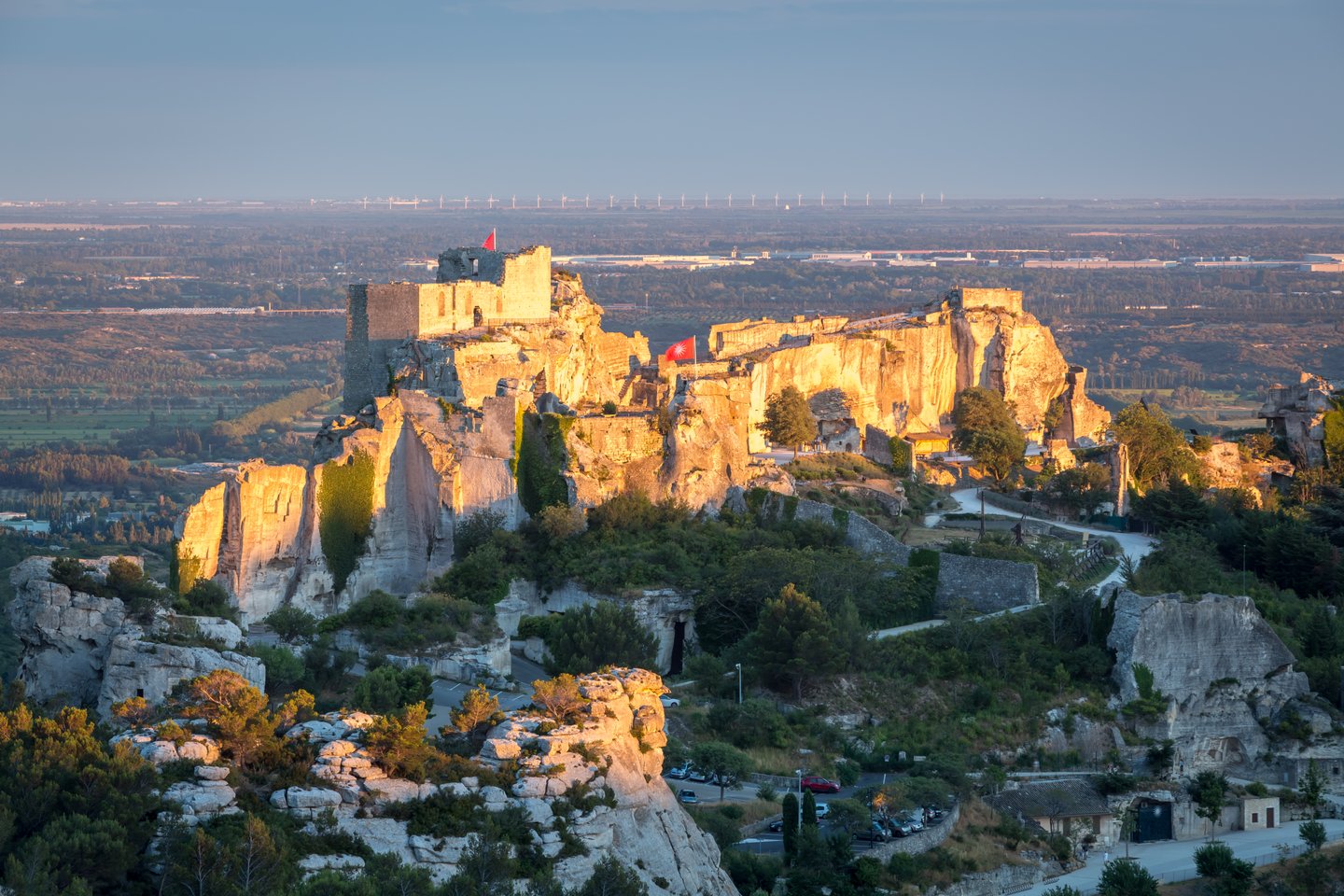
Les Baux-de-Provence rises sharply from the Alpilles, perched on a limestone plateau 250 metres above the surrounding plains.
From here, the view sweeps south towards Arles, the Camargue, and on a clear day, as far as the Mediterranean horizon. This is not just a picturesque setting, it is a position that has shaped its story. The plateau has been a coveted lookout for millennia, and the evidence is in the layers of human history carved into the rock. From the earliest traces of settlement in 6000 BC to its medieval heyday, this natural fortress has been a stage for ambition, survival, and artistry.
In this guide, we explore the story of Les Baux - from its origins and fortified past to the village you can walk through today. You will discover the highlights of the castle ruins, the immersive art at Carrières de Lumières, dining options both indulgent and relaxed, and practical tips for planning your visit. Whether you have an afternoon or a full day, this will help you make the most of your time in one of Provence’s most intriguing historic sites.


From stone to stronghold | the origins of Les-Baux-de-Provence
The name “Les Baux” comes from the Provençal word bau, meaning “escarpment.” The plural form nods to the network of steep slopes that define this natural citadel. The limestone here is not only a backdrop but a resource - soft enough to carve into dwellings, defensive walls, and even entire sections of the keep. Archaeological finds show that Neolithic farmers sought shelter in its caves and used the rocky spur for burials. In later centuries, medieval stonemasons quarried the same material to build the village and fortress that still dominate the skyline today.
By the Middle Ages, Les Baux was the seat of the formidable Lords of Baux - noblemen as ambitious as they were defiant. Claiming descent from Balthazar, one of the biblical Magi, they positioned themselves above the authority of French kings and Holy Roman Emperors alike. From this “eagle’s nest” they launched campaigns across Provence and as far afield as Albania, their banners a familiar sight to friend and foe.
The village was not just a military post. In times of relative peace, Les Baux became a gathering place for troubadours, poets, and wandering minstrels who travelled across Europe. That cultural golden age was punctuated by darker episodes - none more infamous than the arrival of Raymond de Turenne, the so-called Scourge of Provence. His campaign of intimidation included kidnapping locals and forcing those without ransom to step off the cliffs to their deaths. The stronghold’s position made it nearly impossible to challenge such tyranny from below.
It was not until 1632 that Cardinal Richelieu brought an end to Les Baux’s independence, ordering the dismantling of the fortress. For centuries after, the site lay largely abandoned, its walls crumbling under the mistral winds, until the 20th century brought restoration and a new life as one of France’s most visited historic villages.
The Les-Baux-de-Provence village and castle today
Modern visitors find Les Baux split between two distinct areas. The first is the preserved medieval village, its narrow lanes lined with small boutiques, art galleries, and cafés. This part of the settlement is officially recognised as one of Les Plus Beaux Villages de France, a designation given to only a select group of villages with exceptional heritage and architecture. Here you will find 22 buildings listed as Historic Monuments, each telling a part of the town’s layered story.
One of the quieter corners lies around the Eglise Saint-Vincent, its bell tower standing proud against the pale stone. Just beside it, the Chapelle des Pénitents Blancs reveals an unexpected interior, a set of striking modern murals painted within its centuries-old walls. It is in moments like these, away from the main square, that Les Baux shows its more contemplative side.
The second area is the “dead village,” home to the ruins of the medieval fortress spread over seven hectares. Here you can climb the Sarrazine and Paravelle Towers for unmatched views across the Alpilles, explore the dovecote, or stand inside the roofless remains of chapels. The dungeon tower offers the highest vantage point, on a clear day, you can trace the line of the Rhône valley all the way to the distant peaks of the Luberon. Scattered across the site, full-scale replicas of medieval siege engines, catapults, trebuchets, and battering rams, stand ready as if awaiting the next attack. Visitors who like to explore thoroughly will want a full day here; a quick half-day visit will skim the surface but may leave you wishing for more time to wander the ruins, linger in the village, and take in the views from every angle.


Carrières de Lumières
At the foot of Les Baux lies the Carrières de Lumières, an old limestone quarry transformed into a monumental digital art gallery. The quarry’s vast walls, ceiling, and floor become the canvas for immersive projections, each show dedicated to a major artist or movement. Past programmes have brought the swirling skies of Van Gogh to life, filled the space with the water lilies of Monet, and reimagined Michelangelo’s frescoes in shifting light. The experience is heightened by a carefully paired soundtrack, echoing off the stone and creating a sense of movement and depth. It is cool inside all year, refreshing in summer and a little brisk in winter - so a light jacket is worth bringing. Because the exhibitions change annually, the Carrières rewards return visits just as much as it captivates first-timers.
Dining near Les Baux | L’Oustau de Baumanière
For an exceptional dining experience, L’Oustau de Baumanière stands as one of Provence’s most celebrated restaurants. Holding two Michelin stars, it is set within the refined surroundings of a luxury hotel just below Les Baux-de-Provence. Since opening in 1945, it has become synonymous with elegant Provençal gastronomy, where seasonal produce is transformed into dishes that are as precise in execution as they are expressive of the region.
The dining room pairs understated sophistication with views of manicured gardens, while the wine cellar holds an extensive collection of local and international labels to complement each course. Whether you are visiting Les Baux for the day or staying nearby, a meal here elevates the experience into something truly memorable.

Practical information for visitng Les-Baux-de-Provence
Parking: The official castle parking area charges a fee. If mobility is not an issue, you can often find free spaces near the Carrières de Lumières, about a 10–15 minute walk uphill to the village.
Getting there: Les Baux is easiest to reach by car, particularly if coming from smaller towns. Approximate driving times are:
Saint-Rémy-de-Provence – 20 minutes
Arles – 30–40 minutes
Avignon – 40–50 minutes
Nîmes – 45–60 minutes
Aix-en-Provence – 1 hour
Marseille – 1–1.5 hours
Montpellier – 1.5 hours
Toulon – 1.5–2 hours
Public transport links exist from larger cities such as Avignon, Arles, and Marseille, but services are limited. Renting a car offers flexibility and makes it easier to pair your visit with other nearby sites in the Alpilles.
Les Baux-de-Provence is not just a relic from the past - it is a living landscape of stone, sky, and story. Every viewpoint tells you why people have fought to hold it, every wall whispers a fragment of the lives that have passed through. Whether you are here for the history, the art, the food, or simply the view from the top, you will leave with the sense that you have stepped into a place where time layers rather than fades.
À bientôt,
The Provence Holidays Team